
Every time a new technology changes the way we live or work, people have questions.
Will it replace our jobs? Will our skills become useless? Will the world become too dependent on machines? And what happens to people who cannot keep up?
Today, artificial intelligence is bringing these questions back into the spotlight.
Some people see AI as a threat to their careers. Others believe it will change everything we know about work, education, creativity, and business. Many are still trying to understand what AI actually means for their future.
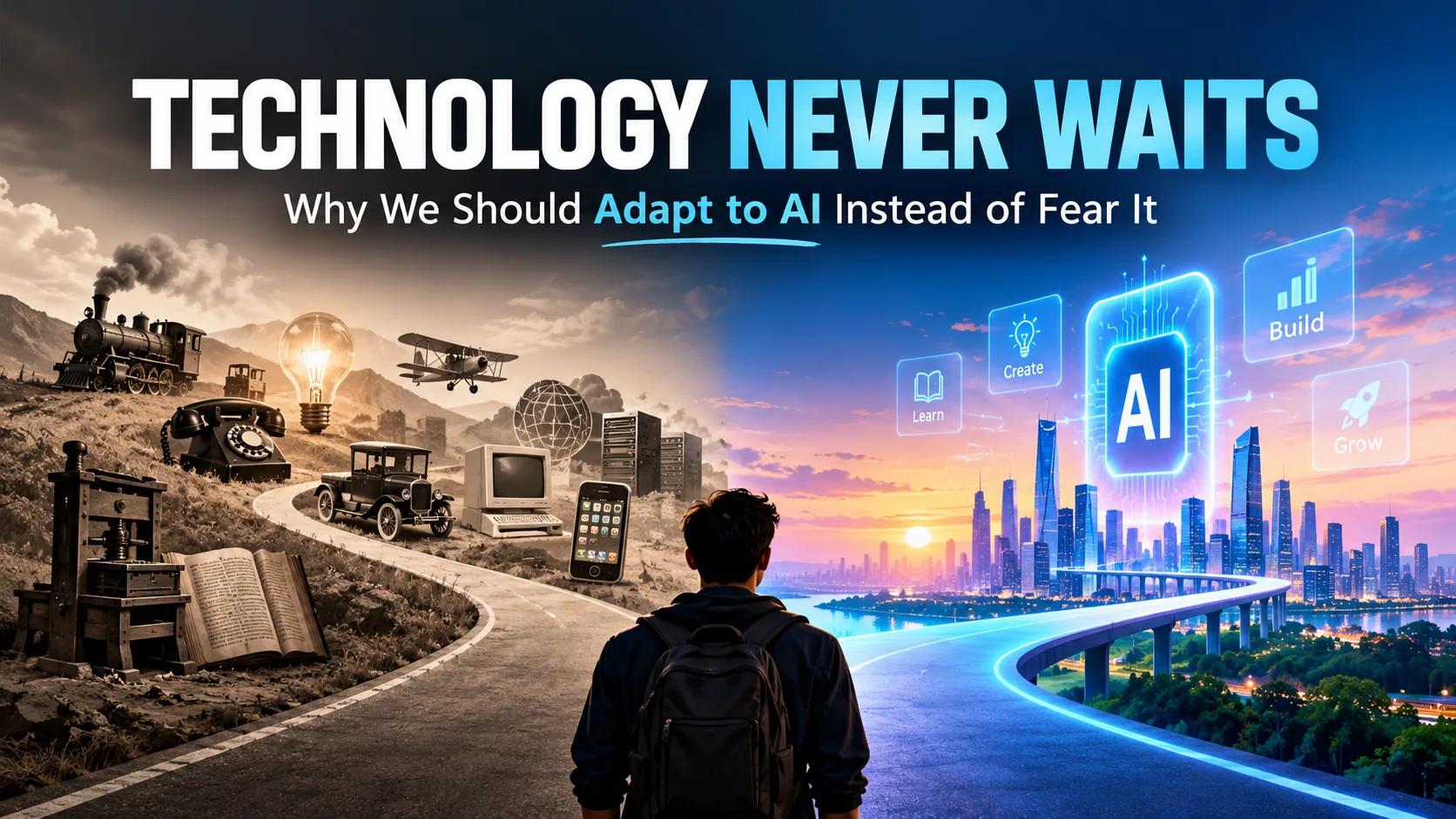
But there is something important we should remember: technology has never stopped changing, and neither has the way humanity adapts to it.
AI is not the first technology to change how we work, and it will not be the last. What makes this moment different is the speed at which AI capabilities are advancing and how quickly ordinary people can access them.
How can we use this technology to become more capable than we were yesterday?
1. Technology Has Always Changed the Way We Live
Look back through history, and you will find that almost every major technological shift changed existing industries, challenged familiar skills, and created new opportunities.
Consider these 12 examples.
1. The Printing Press Changed the Spread of Knowledge
Before printing became widespread, reproducing books was a slow and expensive process. The printing press helped make written knowledge available to far more people and accelerated the spread of ideas.
It changed how information was shared, how people learned, and how knowledge travelled across societies.
2. The Steam Engine Transformed Industrial Work
Steam power helped industries move beyond dependence on human and animal muscle alone. It contributed to the Industrial Revolution, transforming manufacturing, transportation, and production.
Entire industries changed as machines took on work previously performed using traditional methods.
3. Electricity Changed Everyday Life
Electricity transformed factories, homes, communication, and public infrastructure. Work that depended on daylight or mechanical power could increasingly be performed in new ways.
It also created new industries, professions, and possibilities that earlier generations could hardly imagine.
4. The Telephone Changed Communication
Before telephones became widespread, communicating across long distances often required sending physical messages and waiting for a response.
The telephone made direct conversation over distance possible, changing personal communication and business operations.
5. Automobiles Changed Transportation
Cars transformed how people travelled, how goods were transported, and how cities developed.
They also changed existing transportation industries while creating demand for mechanics, road infrastructure, manufacturing, insurance, and countless related services.
6. Assembly Lines Changed Manufacturing
Assembly-line production made it possible to manufacture many products more efficiently and consistently.
It changed the organisation of factory work, increased production capacity, and reshaped the skills businesses needed from their workers.
7. Aviation Made the World More Connected
Air travel reduced the time needed to cross enormous distances. It transformed tourism, international business, logistics, and global relationships.
Industries that depended on physical distance had to adapt to a world that was becoming more connected.
8. Computers Changed How We Process Information
Calculations, records, document creation, and data processing became increasingly digital.
Computers transformed offices and introduced entirely new careers in software development, IT infrastructure, cybersecurity, and data management.
9. The Internet Changed How We Access Information
The internet made it possible to publish, discover, and exchange information globally at unprecedented scale.
Businesses could reach customers online. Individuals could learn from resources beyond their local communities. Entire industries emerged around websites, online services, digital marketing, and e-commerce.
10. Smartphones Put Computing in Our Pockets
A device that once mainly served as a communication tool became a camera, navigation system, entertainment centre, payment method, and learning platform.
Smartphones changed customer behaviour and created opportunities for mobile applications, digital businesses, and services that operate around the clock.
11. Cloud Computing Made Powerful Infrastructure More Accessible
Businesses no longer always needed to purchase and maintain all their own physical servers before launching a digital product.
Cloud services made it easier to access computing infrastructure on demand, experiment with ideas, and scale applications as requirements grew.
12. Artificial Intelligence Is Changing How We Work With Information
AI systems can help people write, code, analyse data, summarise documents, generate images, conduct research, and automate parts of complex workflows.
Modern AI tools can assist with tasks that previously required substantial time, specialised knowledge, or multiple steps performed manually.
This does not mean every task can be automated reliably or that AI has replaced every professional skill. It means the range of work that individuals can accomplish with the right tools is expanding.
The pattern across these examples is clear: technology changes the methods we use, the opportunities available to us, and the skills that become valuable.
But there is an important lesson here. These transitions were not painless. Some jobs disappeared, some professions changed, and some communities struggled to adapt.
History does not promise that everyone will benefit equally. It shows us why adaptation, education, and preparation matter.
2. Why Does AI Feel Different This Time?
AI feels different because it does not affect only one kind of work.
A machine might automate a physical process. A computer might make calculations faster. A website might make information accessible.
AI, however, can assist with several types of knowledge work through a single interface.
A developer can use AI to understand unfamiliar code, generate a starting point for a feature, or investigate a software error. A student can use it to explore a difficult concept. A business owner can use it to draft marketing material, organise information, or automate repetitive administrative tasks.
A single person can now access capabilities that previously required more time, a larger budget, or assistance from multiple specialists.
Think about a small business that cannot afford a large marketing team. AI may help the owner research customers, develop content ideas, draft campaigns, and analyse results.
Think about an independent developer building a software product. AI may help with documentation, testing, debugging, and exploring possible implementations.
These are meaningful advantages.
However, AI is not magic. It can produce incorrect answers, misunderstand context, generate insecure code, and confidently present information that is false. Complex projects still require planning, verification, domain knowledge, and human judgment.
AI is powerful not because it eliminates the need for people, but because it can change what people are capable of doing with their time and resources.
3. The Best Comparison Might Be the Cost of Internet Data in India
One example that helps me understand technological change is the evolution of internet access in India.
I remember a time when mobile data felt expensive and limited. Spending money on a small amount of data required careful consideration. You had to think about how much you used and whether it was worth the cost.
Today, many mobile plans offer large daily data allowances at prices that would once have seemed difficult to imagine.
Of course, pricing depends on the provider, plan, location, and time. But the broader transformation is undeniable: mobile internet has become accessible to far more people.
That change affected much more than how we browsed websites.
It helped people access online education, video platforms, digital payments, social networks, remote work, and online businesses. Students could learn from creators around the world. Small businesses could communicate with customers digitally. Developers could access documentation, courses, and communities from almost anywhere.
Lower costs expanded what people could do.
I see a similar opportunity emerging with AI.
Capabilities that once required expensive specialist resources are increasingly available through affordable tools, open-source models, and accessible online services. The cost is not zero, and advanced systems can still be expensive. But the barrier to experimenting with AI has fallen significantly.
A student can explore programming concepts. A freelancer can develop an initial business workflow. A small company can experiment with customer support automation. A creator can research an unfamiliar subject before producing something useful.
The technology does not automatically create success. It creates another opportunity to do more with the resources available to you.
When a powerful technology becomes more accessible, the advantage shifts toward people who learn how to use it effectively.
4. Writing Code Is Easy to Access. Engineering Is the Real Skill.
Today, almost anyone can use AI to generate code. You can describe an idea, ask for a website, and receive code in seconds. This is one of the most exciting things about AI: it lowers the barrier to building software.
But there is an important distinction we should understand.
Writing code and engineering software are not the same thing.
You can ask AI to write a function, build a user interface, or generate an entire application. But do you understand why the code works? Can you identify security vulnerabilities? Can you design a database that handles growing amounts of data? Can you debug a problem when the generated solution fails? Can you maintain the application when requirements change?
These are engineering questions.
Software engineering is not simply about writing lines of code. It involves understanding problems, designing systems, making technical decisions, evaluating trade-offs, testing assumptions, and ensuring that what you build works reliably in the real world.
AI can help with these activities, but it does not remove the need to understand them.
Think about two people building the same application. One generates code with AI and publishes it without understanding the underlying system. The other uses AI to accelerate development but understands the architecture, reviews the implementation, tests the application, and takes responsibility for its reliability.
Both might produce something that works initially. But when a security issue appears, the database becomes overloaded, or a critical feature breaks, their ability to respond can be very different.
This is why I believe engineering fundamentals will remain important, whether we write code manually, use AI, or work with technologies that have not yet been invented.
You do not need to write every single line of code by hand to be a good engineer. Using AI to generate repetitive code, explore solutions, or speed up development is perfectly reasonable.
The real requirement is that you understand, evaluate, and take responsibility for the system you build.
Code generation is becoming more accessible. Engineering judgment is what helps turn generated code into reliable software.
So, instead of asking only, “Can AI build this for me?”, ask a more valuable question:
“Do I understand what I am building, why it works, and how to make it reliable?”
That is the mindset worth developing with AI or without it.
You need to identify a real problem, understand the people experiencing it, and determine whether AI can help solve it better.
Sometimes the best opportunity is not building another AI application. It is using AI to improve a service that already exists.
6. Yes, AI Will Change Jobs. We Should Take That Seriously.
I do not believe we should dismiss every concern about AI.
Some tasks will be automated. Some roles will change substantially. Some businesses will need fewer people to perform particular activities, while others will create new responsibilities and opportunities.
The transition may be difficult for workers whose existing skills lose market value. Not everyone has the same access to education, equipment, time, or opportunities to retrain.
And learning AI does not guarantee job security. Neither does refusing to use it guarantee that your current work will remain unchanged.
That is why the conversation needs to move beyond two extreme positions: AI will destroy everything, or AI will solve everything.
Neither position adequately describes reality.
A more useful response is to understand which parts of our work are changing, which human capabilities remain valuable, and what we can do to prepare.
For example, someone who only knows how to perform a repetitive task may face a different challenge from someone who understands the underlying problem, can evaluate results, communicates effectively, and knows how to use new tools.
Technical knowledge, critical thinking, creativity, communication, accountability, and domain expertise can complement AI capabilities.
These skills are not automatically immune to automation, but they help people make better use of technology and take responsibility for the results.
We should also recognise that adaptation is not solely an individual responsibility. Employers, educational institutions, governments, and technology companies all have roles to play in supporting people through these changes.
Fear is understandable. Ignoring the change, however, does not prepare us for it.
7. Learn AI Before You Decide What It Means for Your Future
You do not need to master every AI tool available. New products appear frequently, and today’s popular tool may not be the most useful one tomorrow.
Instead, start with the problems you already face.
Here is a practical way to begin.
Step 1: Identify repetitive or difficult tasks
Look at your work, studies, or business. Which activities consume time without requiring much original judgment? Which subjects are difficult to understand? Which processes are unnecessarily complicated?
Start there.
Step 2: Experiment with AI on real problems
Use an AI assistant to explain a concept, summarise a document, generate ideas, analyse non-sensitive data, or help with a small task.
Give it enough context to understand what you need, and ask follow-up questions when the answer is unclear.
Step 3: Learn how to verify the results
Do not assume that a confident answer is a correct answer.
Check important facts against reliable sources. Test generated code. Review calculations. Protect confidential information. Understand the limitations of the system you are using.
Knowing when not to trust AI is part of knowing how to use it.
Step 4: Build something useful
Instead of spending all your time exploring new tools, create something that solves a real problem.
It could be a small automation, a research report, a personal learning project, a customer support workflow, or a better process for managing your daily work.
A small working solution can teach you more than endless experimentation without a clear goal.
Step 5: Keep strengthening your fundamentals
Learn the subject behind the tool.
If you use AI for programming, understand programming. If you use it for marketing, learn about customers and positioning. If you use it for research, learn how to assess evidence.
AI can help you learn faster, but fundamentals help you recognise when its answers are wrong.
Step 6: Measure whether it actually helps
Ask yourself whether the tool saved time, improved quality, reduced costs, or helped you achieve something you could not easily do before.
If it did not, change your approach or use a different tool.
The objective is not to use AI everywhere. It is to use it where it provides genuine value.
8. The Future Will Reward Adaptability More Than Blind Adoption
There is a difference between adopting technology because everyone is talking about it and adopting it because you understand its value.
Not every business needs an AI chatbot. Not every task should be automated. Not every AI-generated result deserves to be published.
Sometimes a simple spreadsheet is better than an elaborate AI workflow. Sometimes a human conversation is more valuable than an automated response. Sometimes the right decision is not to use AI at all.
The point is not to follow every trend.
The point is to remain curious enough to understand new technologies, practical enough to test them, and thoughtful enough to decide where they belong.
Technology changes the tools available to us, but the problems worth solving still matter.
People need reliable services. Businesses need customers. Students need education. Communities need better systems. Individuals need ways to improve their lives.
AI can help us address some of these needs, but it does not remove the responsibility to understand them.
The people who create lasting value will not necessarily be those who use the most AI tools. They will be those who combine useful technology with knowledge, judgment, creativity, and a clear understanding of the people they serve.
Conclusion: Do Not Just Watch the Future Happen
Every generation experiences technologies that change what is possible.
The printing press expanded the reach of knowledge. Electricity transformed everyday life. Computers changed information processing. The internet connected people across the world. Smartphones put powerful digital tools into billions of pockets.
Now AI is opening another chapter.
It will create opportunities, disrupt existing work, and introduce challenges we must take seriously. Its effects will not be equally distributed, and learning to use it will not solve every problem.
But we have a choice in how we respond.
We can spend all our time worrying about what might happen, or we can learn enough to understand the change and make informed decisions about our future.
We can use AI to explore unfamiliar subjects, improve our work, test business ideas, build products, and make knowledge more accessible.
We can also question its limitations, protect our privacy, verify its outputs, and decide when human judgment matters most.
For me, that is the most important lesson.
Do not be so afraid of what technology might change that you miss what it makes possible.
You do not need to predict the entire future. You need to keep learning, remain adaptable, and be willing to experiment.
The next opportunity may not belong exclusively to the biggest company, the most experienced professional, or the person with the largest budget. It may belong to someone who recognises a problem, learns the right tools, and starts building a solution.
Technology will continue to move forward, whether we are ready or not.
The question is not simply whether AI will change our lives.
The question is what we choose to do with it.
What is your perspective on AI? Do you see it mainly as a threat, an opportunity, or a combination of both? I would love to hear your thoughts.