

From Frustration to Fantastic Results
Ever asked an AI for something creative a social media post, an email, a Writing a Product Description for an E-commerce Site and gotten a bland, robotic response that was completely useless? It’s frustrating. You know AI can be a game-changer for your business, but it feels like you’re missing a secret handshake. This wastes your valuable time and makes you wonder if you’re falling behind.
What is a ‘Prompt Engineering’? (Hint: It’s Not as Techy as It Sounds)
Let’s demystify this right away. A prompt is simply a set of instructions you give to an AI.
Think of an AI like a brilliant but very literal new assistant. If you say, “Write about coffee,” they might hand you a 10-page history of the coffee bean—not the snappy Instagram post you wanted.
Vague instructions get vague results. Clear, detailed instructions get great results. That is the core of prompt engineering. By learning how to structure your requests, you go from being a confused user to a confident director, telling the AI exactly what you need.
3 Key Ingredients for Crafting the Perfect Prompt
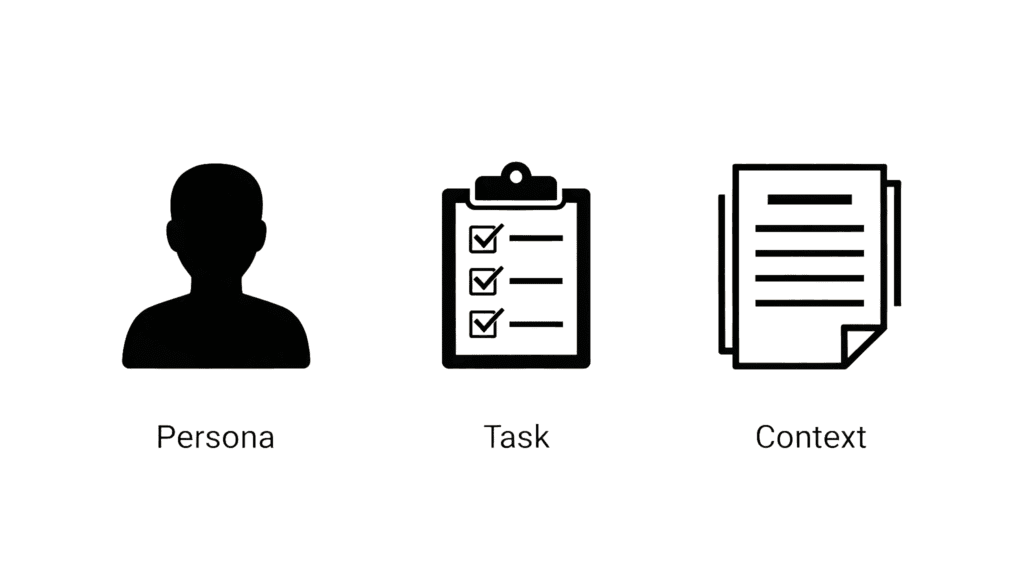
Crafting a perfect prompt isn’t an art; it’s a formula. Nearly every great prompt is built on three core ingredients: The Persona, The Task, and The Context.
Ingredient 1: The Persona (Who should the AI be?)
The first step is to tell the AI who it should be. Assigning a role to the AI helps shape its tone, style, and knowledge scope. You are essentially giving it a professional hat to wear.
Examples of Personas:
- “Act as a friendly and witty social media manager specializing in e-commerce.”
- “You are an expert financial advisor who explains complex topics in simple terms.”
- “Assume the role of a professional copywriter with 10 years of experience in the health and wellness industry.”
Ingredient 2: The Task (What do you want it to do?)
This is the action verb of your prompt. Be specific and crystal clear about your desired output. Don’t just say “write a post”; define the format, length, and goal. The clearer your instructions, the less effort you’ll spend fixing the output.
Examples of Tasks:
- “Write three engaging Instagram captions, each under 40 words.”
- “Generate a list of 10 rhyming tagline ideas.”
- “Create a bulleted summary of the following article…”
Ingredient 3: Context (What background should the AI have?)
Context provides the AI with the background details it needs to produce tailored and relevant answers. This is what transforms plain, generic output into results that fit your brand and audience. Without context, the AI is simply making random guesses.
Examples of Context:
- “I’m launching a dark roast coffee called ‘Midnight Oil’, aimed at college students and young professionals. The tone should be energetic and motivational.”
- “Our company, ‘GreenLeaf Tech,’ sells sustainable office supplies. Our brand voice is professional yet eco-conscious.”
Prompting in Action: Two Real-World Examples
Let’s see how these three ingredients transform a weak prompt into a powerful one.
Example 1: Writing a Product Description for an E-commerce Site
👎 Before (The Bad Prompt): “Write a description for a handmade leather journal.”
- Result: A simple, feature-based description listing the number of pages and the type of leather.
👍 After (The Great Prompt):
Persona: Act as a skilled e-commerce copywriter who specializes in writing persuasive, benefit-driven product descriptions that tell a story.
Task: Write a 150-word product description. Start with a hook that captures the reader’s imagination. Use bullet points to highlight 3 key features and their benefits. Wrap up with a statement that motivates the audience to make a purchase.
Context: The product is a handcrafted leather journal made with recycled paper. The target audience values sustainability, craftsmanship, and mindfulness practices like journaling. The brand voice is artisanal, rustic, and thoughtful.
Example 2: Crafting a Social Media Post for a Local Business
👎 Before (The Bad Prompt): “Write a post about my new coffee blend.”
- Result: A generic, boring paragraph about the taste of coffee that could apply to any coffee shop in the world.
👍 After (The Great Prompt):
Persona: Act as an expert social media copywriter with a fun, energetic, and community-focused tone.
Task: Write one Instagram post to announce a new product. Include an exciting opening line, 2-3 sentences about the product, a clear call-to-action, and 3-5 relevant local and general hashtags.
Context: The product is a new dark roast coffee blend named ‘Midnight Oil.’ The target audience is university students and young professionals in Ahmedabad who are studying for exams. The goal is to drive foot traffic to our physical store on C.G. Road.
FAQ’s
Do I need to be a coder for prompt engineering?
Absolutely not! Prompt engineering is about clear communication, not code. If you can write a clear email or give good instructions to a person, you have all the skills you need to start.
Can I use this 3-ingredient method for any AI tool?
Yes. While different AIs like Google’s Gemini or OpenAI’s ChatGPT have unique strengths, the core principles of Persona, Task, and Context are universal. This framework will improve your results on any major language model.
How long should my prompts be? Is longer always better?
Not necessarily. Clarity beats length. A well-structured 50-word prompt will outperform a rambling 200-word one. Focus on providing precise details for the Persona, Task, and Context. Be as long as you need to be to provide the essential information, but avoid unnecessary fluff that could confuse the AI.
Can I ask the AI to critique its own work?
Yes, and this is a pro-level technique! After the AI gives you a response, you can use a follow-up prompt like, “Great, now review your response. Could you make the tone more casual?” or “Analyze the text you just wrote. How could you make it more persuasive for a skeptical audience?” This forces the AI to refine its own output.
Where can I find more examples of great prompts?
Many online communities and resources are now dedicated to prompting. Websites like FlowGPT and PromptHero allow users to share prompts that work well for specific tasks. Additionally, many AI tools themselves, like Google’s Gemini, often provide examples to get you started. Observing how others structure their prompts is a fantastic way to learn.
Actionable Pro-Tips to Remember
Iterate and Refine: Your first prompt won’t always be perfect. See what the AI gives you and then add or change details to get closer to your goal.
Keep a ‘Prompt Library’: When you create a prompt that works beautifully, save it! You can reuse and adapt your best prompts for future tasks.
Add Negative Guidelines: Sometimes, explaining what the AI shouldn’t do is as important as showing what it should. Try examples like “Do not use formal business language” or “Stay away from clichés.”
Conclusion: Your AI Adventure Starts Now
You now hold the keys to unlocking better AI conversations. By remembering the three simple ingredients—Persona, Task, and Context—you can transform any AI from a confusing tool into a powerful creative partner for your business. You’re no longer just a user; you’re a director, guiding the AI to produce exactly what you need.
Stop settling for generic answers. Start practicing effective prompt engineering today and watch your productivity and creativity soar.
If you want to know more about the new OpenAI GPT-5, check out my post: New OpenAI GPT-5: A Smarter AI for Everyone.
And if you’re curious about AI programming GitHub Copilot tools, don’t miss: GitHub Copilot: Your AI Pair Programmer is Now Free!.
What’s the first ‘great prompt’ you’re going to try for your business using the Persona, Task, and Context framework? Share your ideas in the comments below!