
Imagine compressing a multi-month database or structural migration across a massive enterprise codebase into less than 24 hours. When engineering teams at Stripe tested Anthropic’s newest flagship release on a 50-million-line Ruby application, that is precisely what happened.
What is Claude Fable 5?
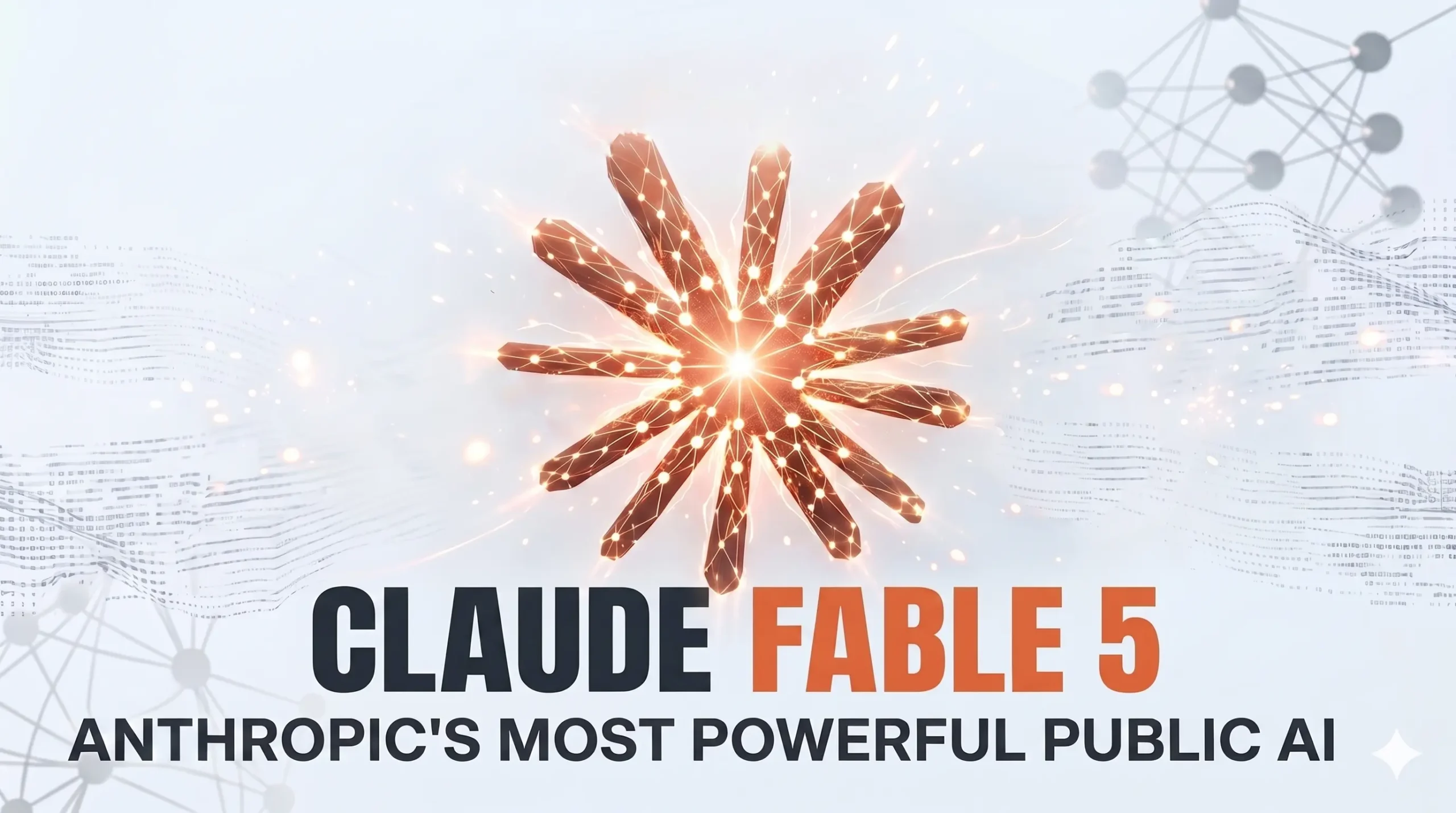
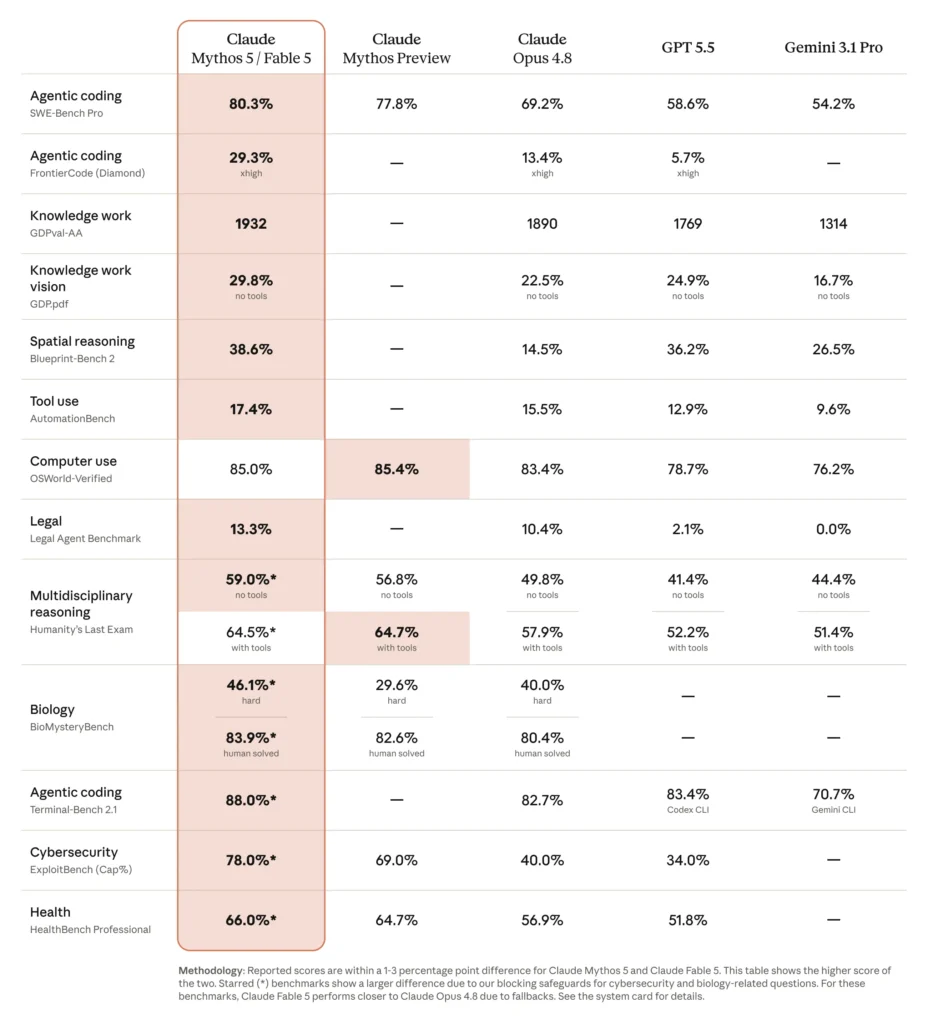
Claude Fable 5 is Anthropic’s newly launched, public-facing “Mythos-class” model. It represents the absolute pinnacle of their current public AI lineup, outperforming previous frontier systems across almost every foundational benchmark. Optimized heavily for long-context comprehension, deep analytical logic, complex vision tasks, and scientific exploration, it becomes a definitive asset for enterprise-grade execution.
Beyond its performance metrics, the financial structure makes it incredibly viable for scalable commercial builds. Anthropic has priced the model aggressively:
- Input Tokens: $10 per million
- Output Tokens: $50 per million
This represents a cost reduction of over 50% compared to the older Claude Mythos Preview, effectively removing the budget barriers that previously made deep agentic loops too expensive for production software.
Main Sections: Breaking Down the Breakthroughs
A. Codebase Migrations & Software Engineering Performance
For those of us working daily with complex systems, Node.js microservices, or deep legacy codebases, the software engineering benchmarks are staggering.
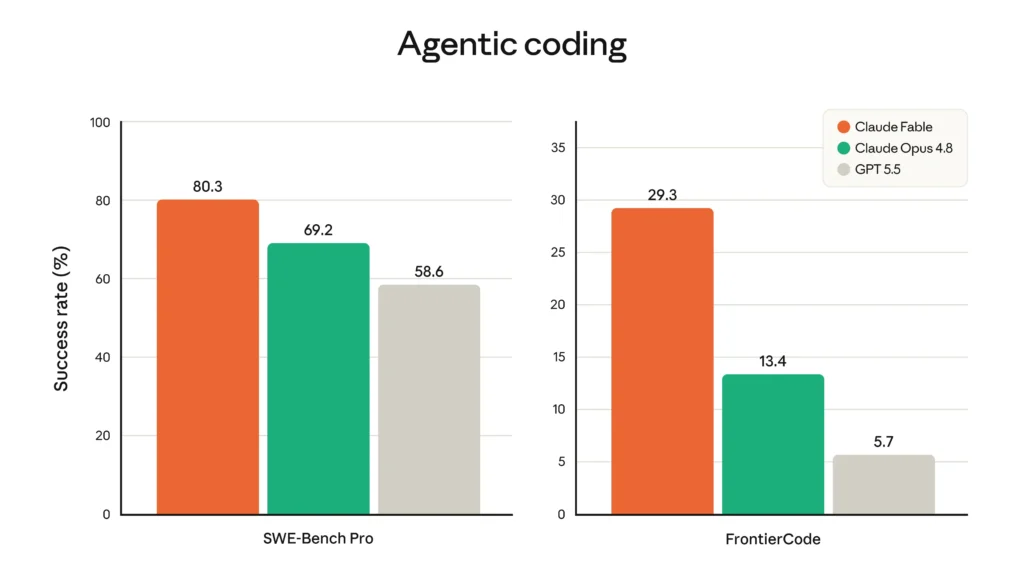
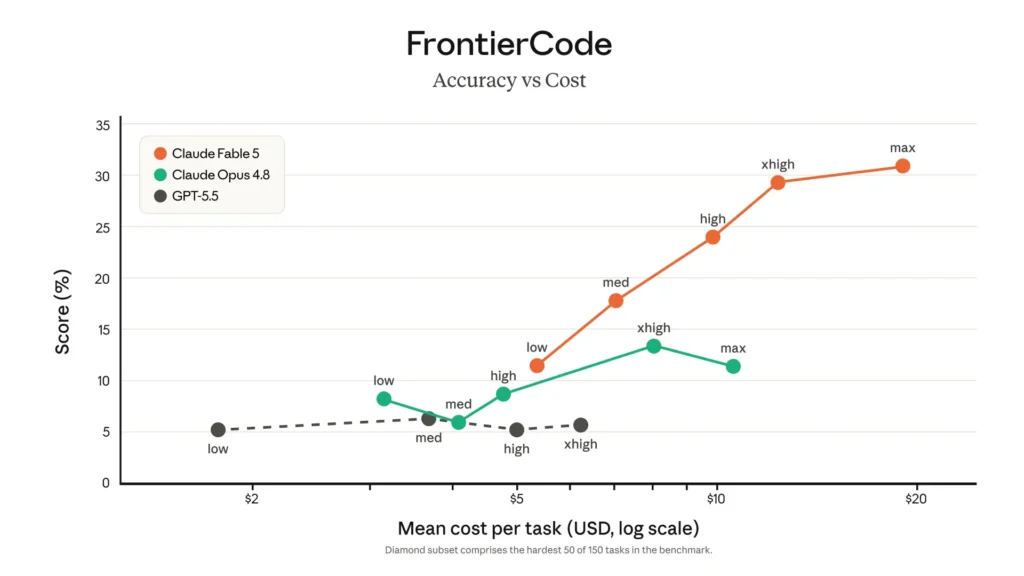
During production trials, the model managed full-scale codebase overhauls autonomously. It completely bypasses the token-wasting patterns of older generation systems. On Cognition’s FrontierCode evaluation—which scores models on their ability to write high-quality production code while maintaining strict style guidelines—Fable 5 ranked highest among frontier systems, even when working under medium-effort constraints. It produces clean, modular code ready to pass strict CI/CD pipelines without requiring constant human refactoring.
B. Long-Running Autonomous Agent Architecture
Where Fable 5 truly separates itself from past models is its ability to operate cleanly within an autonomous loop over thousands of sequential steps without losing its structural focus.
In behavioral evaluations using complex strategy platforms like Slay the Spire, giving the model access to file-based notes improved its success rate three times more effectively than it did for Claude Opus 4.8. The model systematically writes down structural execution logs, critiques its own performance, and updates its strategy file to overcome roadblocks without human intervention.
C. Advanced Vision Capabilities & UI Engineering
The model sets an entirely new benchmark for multimodal processing. In the past, guiding an AI to interact with complex graphical interfaces required heavy framework scaffolding, map coordinates, and programmatic harnesses. Fable 5 completely removes that friction:
- Zero-Scaffolding Gameplay: The model successfully defeated Pokémon FireRed using absolutely zero spatial aids, map coordinates, or backend memory injections—navigating purely by analyzing raw, sequential game screenshots.
- Design-to-Code Pipelines: For frontend engineering teams, it can ingest flat UI mockups or application screenshots and autonomously generate functional, production-ready web application source code from scratch.
- Technical Data Extraction: It reads dense, multi-axis scientific figures and complex financial charts with perfect spatial accuracy.
The Safeguard Dilemma & Claude Mythos 5
Deploying an engine with this level of reasoning introduces real structural risks, particularly regarding advanced cybersecurity exploitation. To manage this safely, Anthropic split the release into two distinct pipelines:
- Claude Fable 5 (Public Tier): Features conservative safety filters designed to detect potential malicious queries. If a request triggers a safeguard, the pipeline automatically hands the task over to Claude Opus 4.8. These safety filters trigger on average in less than 5% of user conversational sessions.
- Claude Mythos 5 (Restricted Tier): The exact same underlying foundational model, but with defensive filters lifted for critical infrastructure operators. Deployed initially via Project Glasswing in absolute alignment with the United States government, it is currently rated as the most capable cybersecurity defensive system globally.
4. FAQ Section
How much does it cost to run Claude Fable 5 in production?
Fable 5 costs $10 per million input tokens and $50 per million output tokens. This represents a massive price drop of more than 50% compared to the older Claude Mythos Preview tier, making it highly affordable for scaling complex agent workflows.
What happens if my development prompt triggers a safety filter?
If a highly complex technical query accidentally triggers the conservative safety guardrails, the system smoothly switches the request to Claude Opus 4.8. This safeguard triggers in fewer than 5% of active sessions on average.
Can Fable 5 build frontend code directly from design screenshots?
Yes. Fable 5 features state-of-the-art vision processing that allows it to analyze raw visual UI elements, map out layouts, and reconstruct full functional source code directly from static application screenshots.
Actionable Tips for Engineering Teams
- Streamline Your UI Scaffolding: Stop spending valuable time writing heavy custom code to break down user interfaces into clean JSON coordinate maps for your AI tools. Fable 5’s raw vision engine can read the layout directly, saving processing overhead.
- Configure File-Based Log Buffers: When building autonomous background tasks, create a tool loop that lets the model write its own markdown notes to a persistent text file. This lets it cross-reference its history and eliminates context drift over long runtime operations.
Conclusion
The public introduction of a Mythos-class framework marks an incredible inflection point for full-stack engineers and automation agencies globally. By offering deep, multi-day autonomous execution loops, state-of-the-art vision parsing, and a massive 50% price reduction over previous developer previews, Anthropic has turned highly advanced, theoretical agentic concepts into an everyday production reality. If you want to keep your development cycles fast and lean, it is time to open up your IDE, configure your API keys, and start exploring the raw potential of Claude Fable 5.
Reader Interaction & Insights
How will you use this model? Are you planning to drop it into your current backend pipelines for automated refactoring, or are you looking to exploit its raw vision engine for custom UI generation? Let me know your architectural ideas and pipeline strategies in the comment section below!
For More official information Read Claude Fable 5 and Claude Mythos 5
(all this 3 image source is the office post)