


Imagine buying a brand-new, ultra-fast computer, only to realize every single accessory—your mouse, keyboard, and monitor—requires a completely different, custom-built plug to work. Frustrating, right? Until recently, that was exactly how Artificial Intelligence (AI) connected to your business data.
Enter the Model Context Protocol (MCP). Introduced by Anthropic and now a booming open standard supported across the industry in 2026, MCP is the universal adapter for AI. In this guide, you will learn exactly what this breakthrough technology is, how it transforms AI from a simple chatbot into a capable digital employee, and why adopting it now will give your business a massive competitive edge.
The N×M Integration Problem (Why AI Was Stuck)
A. The Old AI Space: Isolated and Limited Before the Model Context Protocol, AI was essentially trapped in a box. It could chat and answer general questions, but it couldn’t actually do much for your specific workflow.
If an app updated its system, the connection broke. This was known as the “N×M” integration problem—a nightmare that stopped businesses from truly automating their operations.
B. The New AI: Connected and Capable Think of the Model Context Protocol as the “USB-C for AI tools.” Just like USB-C allows you to plug almost any device into any computer with one standard cable, MCP provides one standard language for AI to talk to any external system.
Old AI: Only chats, limited actions, generic answers.
New AI with MCP: Reads internal documents, uses software, talks with APIs, and automates real business tasks.
How Model Context Protocol Works in Real Life
Let’s look at how MCP works in a real-world business scenario using simple steps.
Imagine you ask your AI assistant: “Find the last month’s sales report in our database and send a summary to my team on Slack.”
Without MCP, the AI replies: “I don’t have access to your database or Slack.”
With MCP, the workflow is seamless:
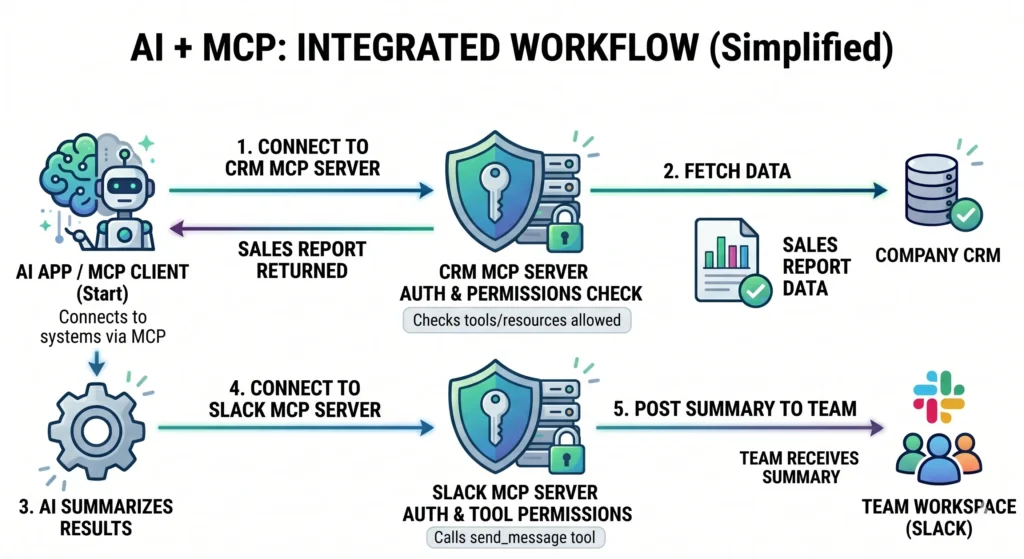
- Connection: The AI (acting as the MCP Client) connects to your company’s CRM via a secure MCP Server.
- Retrieval: It securely opens the sales report, using only the permissions you’ve explicitly granted.
- Action: It creates a summary and uses the Slack MCP Server to instantly message your team.
User asks:
"Find the last month’s sales report in our database and send a summary to my team on Slack."

AI App / MCP Client
   ↓
Connects to CRM MCP Server
   ↓
Auth check + allowed tools/resources
   ↓
Fetch sales report data
   ↓
AI summarizes results
   ↓
Connects to Slack MCP Server
   ↓
Calls send_message tool
   ↓
Posts summary to team
FAQ: Understanding MCP in AI
Is Model Context Protocol secure?
Yes. A core benefit of MCP is that the host (your machine or company server) retains full control over the data. The protocol uses strict permission boundaries, meaning the AI only accesses the specific files and systems you explicitly authorize.
Who supports MCP?
As of 2026, it is a universally adopted standard managed under the Linux Foundation’s Agentic AI Foundation. Major tech players, including Anthropic, OpenAI, Microsoft, and Google, all support MCP integrations.
Can I create my own MCP for my software?
Yes. You can build your own MCP server or integration for your software, tools, database, CRM, or internal systems. This allows AI models to securely connect and interact with your platform.
Why should developers learn MCP now?
Developers who learn MCP early can build smarter AI apps, automation systems, and business integrations faster than others. Early adopters may gain a strong advantage.
What can MCP do in real life?
MCP can help AI read files, update records, send emails, create reports, access business data, automate workflows, and act like a useful AI assistant inside software.
Why MCP Matters
If you want your business to thrive in the next era of technology, understanding AI workflow systems is just as crucial as having a mobile-friendly website was ten years ago.
Data-Driven Insight: According to recent 2026 industry surveys, over 70% of businesses actively adopting AI expect their usage of MCP to increase significantly this year. Financial and tech institutions are already reporting that MCP-enabled workflows drop manual investigation times from 8 hours down to under 45 minutes.
Early adopters who understand how to deploy AI agents with MCP are gaining a massive advantage by turning manual, hours-long tasks into instant, automated background processes.
See how Claude Skills helps automate tasks, save time, and improve consistency with AI Anthropic Claude Skills: Download & Use
Model context Protocol Documentation: Model Context Protocol
Conclusion: The Future of AI Automation
By turning AI from a passive chatbot into an active, secure digital employee, MCP solves the integration crisis and unlocks the true promise of AI automation. Businesses that leverage these open standards today will build the fastest, most scalable workflows of tomorrow.
Comment below: Which internal tool or data source would you connect your AI to first if you could do it instantly?
1 Comment
Comments are closed.


[…] What is Model Context Protocol? The USB-C for AI Agents: How Model Context Protocol Works in Real Life […]